


No.166 The Legacy of the Tokyo 2025 Deaflympics


From November 15 to 26 last month, the first Deaflympics (an international multi-sport event for the hearing impaired) was held in Japan. At this historic event, Ayami Matsunaga from Inagi City was selected as a member of the Japanese women's deaf volleyball national team.
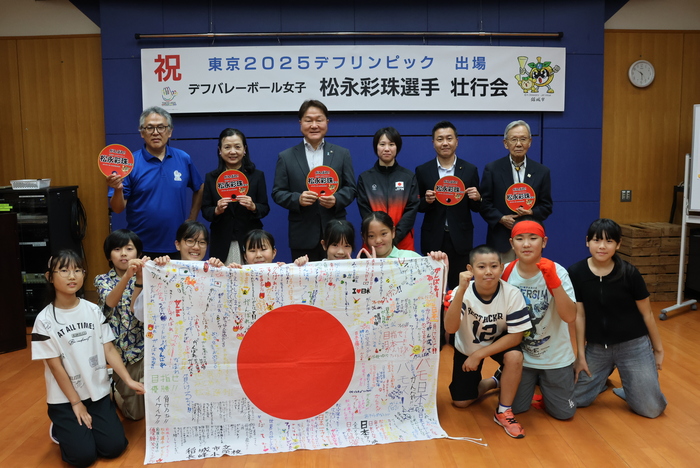
When Ms. Matsunaga was selected as a member of the Japan national team, she was certified as an "Inagi City Hometown Athlete." The certification ceremony was held on August 22, and a send-off party was held on September 24 to send her off to the Deaflympics.
Ms. Matsunaga has congenital sensorineural hearing loss. She is from Inagi City and graduated from the Kindergarten Department of the Japan School for the Deaf, Nagamine Elementary School of Inagi City Public Schools, Tokyo Metropolitan Central School for the Deaf, and the Tokyo Metropolitan Tachikawa School for the Deaf Specialized Course. She is currently employed at a company in Tokyo.
She started playing volleyball in the first year of junior high school and rapidly improved. Recently, she won first place at the 24th Tokyo Metropolitan Disabled Sports Tournament in FY2024, the Deaf Volleyball World Championship in Tomigusuku City, Okinawa, and in FY2025, she won the 26th Japan Deaf Volleyball Cup Kawasaki Tournament.
Deaf volleyball is played under the same rules as regular volleyball, but at the Deaflympics, the use of hearing aids is prohibited during competition, so players cannot hear their teammates' voices, the referee's whistle, or the sound of the ball being hit. Players and coaches communicate using sign language, eye contact, body language, and other non-verbal methods. Under these conditions of silence, players must rely on their own vision to make split-second decisions, requiring pure physical ability and mental strength that transcend words and sounds, as well as sharpened concentration.
Also, cheers from the audience do not reach the players through voices or sounds. At the send-off party on September 24, with the cooperation of the Inagi City Association of the Deaf, all participants learned simple sign language and cheering signs together.
The Japan women's national deaf volleyball team advanced to the final tournament with a perfect record in the preliminary league. As announced, a public viewing was held at the Community Promotion Plaza for the final match on November 25, where many citizens came to support them. As a result, they defeated the strong opponent Turkey 3-0 and splendidly won the gold medal.
The Deaflympics is the pinnacle event of sports for people with disabilities, alongside the Paralympics. While the Paralympics are considered to have begun with the Rome Games held in 1960, the Deaflympics originated with the 1924 Summer Paris Games, making it an event with a longer history than the Paralympics.
This Tokyo tournament marked the memorable 25th edition, spanning over 100 years. Japan won 16 gold medals, ranking third after Ukraine with 32 and the United States with 17. Additionally, Japan secured a total of 51 medals, placing second after Ukraine's 100, representing a significant leap far exceeding the goals set.
The Deaflympics, through being held in Tokyo this time and the outstanding performance of the Japanese team, have gained recognition comparable to that of the Paralympics.
Furthermore, in advancing understanding of disabilities, it is precisely in this "communication without sound" that hints for coexistence, which we should learn from, may be hidden. I believe it has provided an excellent opportunity for each of us citizens to deepen our understanding of hearing impairments and to consider the ideal form of a symbiotic society.
Until now, sign language and finger spelling were considered special skills, but the Deaflympics served as a catalyst, increasing opportunities for the general public to use simple sign language and signs. Taking this as an opportunity, the importance of promoting barrier-free communication has been recognized.
We want to preserve this moving experience not just as a mere memory, but as a legacy that illuminates the future of Inagi toward the great goal of a symbiotic society.
This page is managed by the Planning Department, Secretarial and Public Relations Division
2111 Higashi-Naganuma, Inagi City, Tokyo 206-8601
Phone number: 042-378-2111 Fax number: 042-377-4781
Contact the Planning Department, Secretarial and Public Relations Division of Inagi City